




Key Takeaways
- Kitten growth stages move quickly, from dependence in the first weeks to increasing confidence and independence over the first year.
- The early months are useful for establishing litter, grooming, scratching, handling, carrier, feeding, and play routines.
- Positive exposure should be gradual. The aim is familiarity, not forcing a kitten to tolerate every experience.
- Early habits still need reinforcing as kittens grow and begin testing boundaries.
Introduction
Kittens change dramatically during their first year. In the earliest weeks, they depend on their mother, but within months they eat independently, explore, play, and develop routines that may continue into adulthood.
Understanding kitten growth stages therefore helps with more than tracking physical development. It gives owners a useful guide to when everyday habits can start becoming familiar.
The early weeks are particularly important because the main socialisation period occurs at roughly two to seven weeks of age. Positive, manageable experiences with people, handling, sounds, toys, and ordinary environments during this period can influence how familiar those experiences feel later.
By the time most kittens join their new families, some of that foundation has already been built. The owner’s role is to continue it without changing everything at once.
What Does the Kitten Growth Timeline Look Like?
A simple guide to kitten development by age helps put those habits into context.
| Age | Typical Development | Useful Foundations |
|---|---|---|
| Birth to 2 weeks | Highly dependent on mother | Gentle breeder-led handling where appropriate |
| 2 to 8 weeks | Rapid sensory, social, and physical development | People, household sounds, litter, toys, gentle handling |
| 8 to 12 weeks | More independent and adapting to a new home | Litter consistency, carrier, grooming, scratching surfaces |
| 3 to 6 months | More energetic, curious, and physically capable | Toy-based play, feeding routines, paw handling |
| 6 to 12 months | Increasing independence and clearer preferences | Reinforcing routines, enrichment, grooming, appropriate play |
Kitten development stages vary by individual, so treat this as an estimate.
1. Protect Good Litter Habits
Many kittens already understand litter trays before moving home. We usually advise owners to make continuation easy rather than reteach toileting.
Keep the tray accessible, clean, and in a relatively quiet spot. Starting with familiar litter can also reduce the number of changes a kitten faces during its first days at home.
2. Introduce Grooming Early
Grooming is easier to establish when there is no urgent knot or mat to remove.
Start with a few calm brush strokes, then stop before the kitten becomes frustrated. We also encourage gentle paw, ear, and body handling so brushing, nail care, basic health checks, and veterinary handling feel less unfamiliar later.
Families considering Munchkin cats should still focus on the individual kitten rather than assuming one handling preference applies to the whole breed.
3. Give Scratching an Appropriate Outlet
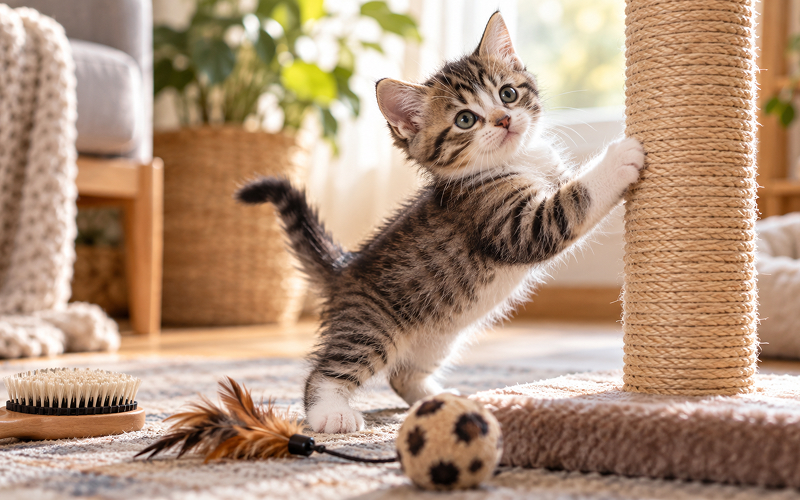
Scratching is normal behaviour, so the useful habit is not “do not scratch”. It is “scratch here”.
Place suitable posts or pads where your kitten naturally spends time. If furniture becomes attractive, redirect the kitten towards an appropriate scratching surface rather than relying on punishment.
4. Make the Carrier Part of Normal Life
A carrier should ideally mean more than “we are going to the vet”.
Leave it accessible at times with familiar bedding inside. Let your kitten investigate and rest in it freely. Later, practise briefly closing and reopening the door.
The goal is to familiarise the kitten with the carrier.
5. Do Not Use Hands for Rough Play
During several developmental stages, chasing, pouncing, grabbing, and biting are normal parts of play.
Hands can become targets if owners encourage wrestling with fingers. Wand toys, balls, and other appropriate toys give kittens better outlets for those behaviours.
It may seem harmless with a tiny kitten, but the same habit becomes much more noticeable as the cat grows.
6. Build Predictable Feeding and Household Routines
Kittens benefit from consistency around meals, play, rest, and daily interaction.
This does not require an exact timetable. It means avoiding habits you already know you will not want later, such as feeding from the dining table or offering food every time a kitten vocalises.
The same principle applies to household sounds and visitors. Introduce normal experiences gradually, and always provide somewhere safe to retreat.
For families planning to buy a cat in Singapore, it is worth thinking about these routines before collection day.
Which Habits Matter Most?
As your kitten moves through the main growth stages, focus on habits that make everyday care and home life easier over time.
| Habit | Why Establish It Early? |
|---|---|
| Litter routine | Keeps toileting predictable |
| Grooming | Builds familiarity with coat care |
| Paw and body handling | Supports nail care and health checks |
| Scratching surfaces | Gives natural behaviour an appropriate outlet |
| Carrier familiarity | Makes necessary transport less unfamiliar |
| Toy-based play | Keeps hands from becoming play targets |
| Feeding routine | Creates clearer expectations around meals |
The objective is not a perfectly trained kitten. It is to make useful behaviours ordinary through repetition.
How We Help Xi Meow Kittens Build Early Foundations
At Xi Meow, our kittens receive regular human interaction before joining their new families. We also share what each kitten is already accustomed to, including handling, feeding routines, and general personality.
When families look at kittens for sale, we encourage them to think about the adult cat they are raising as well as the kitten they are bringing home.
If you would like to meet our kittens and ask about their current routines, you can book an appointment with Xi Meow.
Frequently Asked Questions
What is the most important stage of kitten development?
The early socialisation period is especially influential, but learning continues afterwards. Keep reinforcing positive handling, grooming, play, feeding, and household routines as your kitten grows.
When should I start grooming my kitten?
Start while the coat is still easy to manage. Keep early sessions brief and positive, then gradually increase grooming as your kitten becomes comfortable with the brush and handling.
At what stage of growth do kittens become more independent?
Independence develops gradually. Kittens become increasingly self-sufficient during their first month but still need consistent care, interaction, supervision, and age-appropriate routines.
