




Key Takeaways
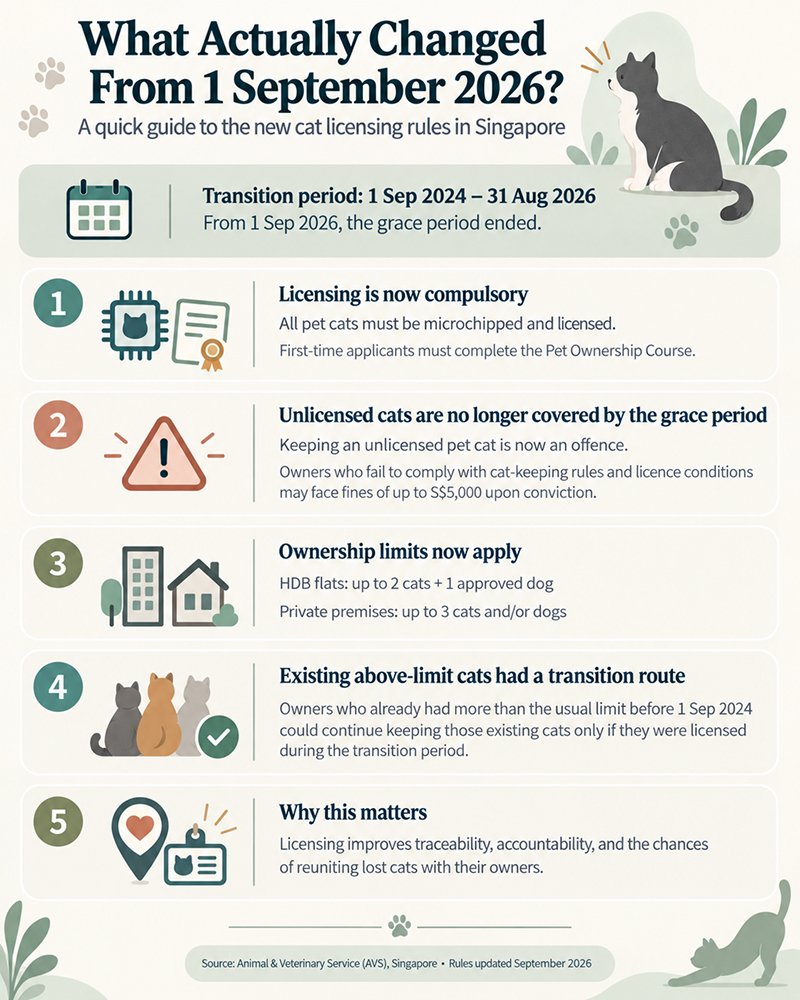
- From 1 September 2026, keeping an unlicensed pet cat is an offence in Singapore. The two-year transition period has ended, so cat licensing is now part of normal pet ownership.
- All pet cats must be microchipped before they can be licensed. First-time cat or dog licence applicants must also complete the Pet Ownership Course.
- The standard limit is up to two cats in an HDB flat, together with one approved dog, and up to three cats and/or dogs in private premises.
- Sterilised cats can qualify for a one-time licence, while non-sterilised cats require time-limited licences at higher fees.
- Before bringing home another kitten, check your household’s existing pets, licensing position, home safety, and the records that will be transferred with the cat.
What Actually Changed From 1 September 2026?
Singapore introduced its Cat Management Framework on 1 September 2024, but owners were given a two-year transition period to adjust. That transition ended on 31 August 2026.
Singapore’s cat licensing did not suddenly begin in September 2026. The licensing scheme had already been in place for two years. What changed is that the grace period ended, standard ownership limits now apply to new licence applications, and keeping an unlicensed pet cat is now an offence.
At Xi Meow, we think this is useful for families who may have heard different dates mentioned online. The Singapore cat licensing rules began in 2024, while enforcement after the transition period applies from 1 September 2026.
AVS states that all pet cats must be licensed, primarily to improve traceability during disease outbreaks and to connect a cat’s identity with its registered owner. Owners who fail to comply with the cat-keeping rules and licence conditions may face a fine of up to S$5,000 upon conviction.
For owners, this cat licensing decision by Singapore is best understood as one part of responsible ownership rather than simply another administrative form.
Why Microchipping Comes Before the Licence
Before applying for a licence, your cat must be microchipped.
A microchip provides a unique identification number. Once that number is connected to the cat’s licence and current owner details, authorities have a way to trace ownership and identify the animal if it becomes lost.
This is why pet cat licensing requirements begin with permanent identification. A chip on its own is not the same as a licence, and a licence application requires the cat’s microchip number.
For families considering buying a kitten, we recommend keeping the microchip number, vaccination records, health documents, and ownership paperwork together from the start.
The same applies whether you are looking at British Longhair kittens or any other breed.
Under the cat licensing rules in Singapore, the registered owner should also keep the licence details current if the cat changes address or ownership.
The Pet Ownership Course and PALS Application
First-time cat or dog licence applicants must complete AVS’ free online Pet Ownership Course before applying.
The course takes approximately 20 to 30 minutes and covers animal biology, pet care and health, responsible ownership, and relevant rules. After completion, you can proceed with licensing your cat in Singapore through the Pet Animal Licensing System, or PALS.
Before starting the application, we recommend having your cat’s microchip number ready. Depending on the animal and circumstances, you may also need supporting documents relating to sterilisation, adoption or fostering, or importation.
The pet ownership course is therefore not simply a general recommendation. It is a requirement for first-time cat or dog licence applicants before they proceed with their licence application.
This is one reason we encourage families buying a cat in Singapore to think about the paperwork before the kitten comes home rather than afterwards.
What Are the Current Cat Ownership Limits?
The ownership limits are especially important for families owning a cat in HDB housing.
Under Singapore’s cat licence framework, an HDB household may generally keep up to two cats as well as one dog of an approved breed. In private premises, the standard limit is three cats and/or dogs in total.
AVS’ current cat ownership limit guidance also explains how the transition arrangements apply to owners who already had cats before 1 September 2024.
The cat management framework allowed owners with existing cats above the normal limit to continue keeping them if those cats were licensed during the transition period and their welfare was properly maintained. This did not permanently increase the HDB or private-property limits for newly acquired cats.
That is why cat licensing now matters before you commit to another pet. Count the cats and dogs already registered to your household first.
If you are ready to welcome a kitten into your home, explore our British Shorthair kittens for sale and speak with us about availability, suitability, and what to prepare before bringing your kitten home.
Cat Licensing Is No Longer Free
Cat licences were issued free during the two-year transition period. From 1 September 2026, standard licensing fees apply.
There is one category that is particularly relevant if you are bringing home a kitten. AVS lists a S$15 one-year licence for cats and dogs below five months of age, separate from the standard fees for the first three pets.
For cats and dogs aged five months and above, the fees also depend on how many licensed cats and dogs you have and, for the first three pets, whether the animal has been sterilised.
| Licence category | 1 year | 2 years | 3 years | One-time |
|---|---|---|---|---|
| Cat below 5 months | S$15 | N.A. | N.A. | N.A. |
| First 3 pets: sterilised | S$15 | S$25 | N.A. | S$35 |
| First 3 pets: non-sterilised | S$90 | S$165 | S$230 | N.A. |
| 4th and subsequent pet | S$180 | S$325 | S$460 for non-sterilised | S$460 for sterilised |
AVS also provides reduced fees in specific circumstances for a qualifying fourth pet. For cats, this applies where the animal is sterilised and adopted from an AVS animal welfare rehoming partner. A 10% rebate is also available for specified electronic payment methods.
For families buying a young kitten, the under-five-month fee is therefore the figure to pay attention to first. As your cat grows, the applicable licence or renewal options will depend on factors such as sterilisation status and the number of licensed cats and dogs in your household.
Sterilisation itself is not compulsory under cat licensing in singapore. However, AVS offers substantially lower long-term licence fees for sterilised cats, including a S$35 one-time licence for sterilised cats among the first three pets.
We recommend checking the latest AVS fee schedule when you are ready to apply, particularly if you already have several licensed pets at home.
Why Indoor Cats Still Need to Be Licensed
We sometimes hear a reasonable question from owners: if my cat never goes outside, why does it still need a licence?
The rule applies to pet cats regardless of whether they are indoor-only. Pet cat registration in Singapore is based on the animal being kept as a pet, not how frequently it leaves the home. Community cats are treated separately.
Indoor ownership also comes with safety responsibilities. AVS expects owners to keep cats in a safe environment, take reasonable precautions against falls from height, prevent uncontrolled roaming, and keep cats under physical control when they are in public.
That means cat licensing does not replace home preparation. Windows, balconies, service yards, and frequently opened doors still need to be considered carefully.
For new owners, we usually recommend preparing the home before collection day rather than assuming escape or fall risks can be solved after the kitten arrives.
What Multi-Cat Households Should Check
Multi-cat households need to pay particular attention to when their cats were acquired and whether they were licensed during the transition period.
An owner who already had more than the usual limit before 1 September 2024 could continue keeping those existing cats if they were licensed during the transition period and the applicable conditions were met. That was a grandfathering arrangement, not a general exemption for future cats.
The rules now make it especially important to check your household’s current position before adding another cat.
In practical terms, cat licensing should be part of the decision before you reserve a kitten. We would rather see a family confirm that another cat can legally and comfortably fit into the household than discover a problem after payment or collection.
What We Recommend Checking Before Bringing Home Another Cat
We recommend treating licensing as one part of a wider pre-purchase check.
| What to check | Why we ask families to consider it |
|---|---|
| Existing cats and dogs | Confirm that the household remains within the applicable ownership limit. |
| Microchip | Check whether the cat is microchipped and obtain the identification number. |
| Health records | Keep vaccination, veterinary, and other supporting records together. |
| Sterilisation status | Know whether the cat is sterilised and what documentation is available. |
| Licence status | Check whether a new application or ownership transfer is required. |
| Home setup | Secure windows, balconies, service yards, and other possible escape or fall points. |
| Long-term commitment | Make sure the household is ready for the costs, care, and responsibilities involved throughout the cat’s life. |
These cat ownership licensing rules may sound administrative, but they are easiest to manage when treated as part of the acquisition process.
At Xi Meow, we also encourage families to look beyond colour, face shape, or breed. If you are bringing home a kitten, the more useful questions are whether its temperament suits your household, whether you understand its care needs, and whether you are prepared for the years of responsibility ahead.
How We Prepare New Cat Owners at Xi Meow
At Xi Meow, we see cat licensing as part of the wider preparation that should happen before a kitten joins your family. It is also one of the areas new owners may be unfamiliar with, which is why we created this guide in the first place.
Our role is not simply to help someone choose a kitten that looks appealing. We can advise families on what to prepare before bringing a kitten home, including its health records, microchip details, licensing responsibilities, home setup, and ongoing care needs.
When families visit us, we also encourage them to ask how the kitten behaves, what it is currently eating, what litter setup it is familiar with, and what changes should be introduced gradually. We can walk you through these practical details so you have a clearer idea of what to expect during the first few weeks.
If you are unsure about the licensing process, what documents you should keep, or what needs to be prepared before collection, speak with us during your visit. While the licence application itself is completed by the owner through the relevant government system, we can help you understand the steps and the information associated with your kitten.
If you are considering a British Shorthair, British Longhair, Ragdoll, Munchkin, or another kitten, you can book an appointment to meet our kittens and let us advise you on what to prepare before bringing one home.
Frequently Asked Questions About Cat Licensing
How do you get a cat license in Singapore?
Microchip your cat first. If you are a first-time cat or dog licence applicant, complete the Pet Ownership Course, then apply through PALS with the required information and supporting documents.
Does an indoor cat still need a licence?
Yes. The mandatory cat licensing rules apply to pet cats even if they live entirely indoors. Community cats are handled separately and do not require ordinary pet-cat licences.
Can I keep more than two cats in an HDB flat?
The standard limit is two cats, together with one approved dog. Owners who had more cats before 1 September 2024 may continue keeping them if they qualified for the transition arrangement and licensed them by 31 August 2026.
Is a microchip the same as a cat licence?
No. A microchip provides the identification number used during licensing, but the cat still needs to be licensed through PALS.
Does my cat have to be sterilised to get a licence?
No. Licensing requirements for pet cats allow both sterilised and non-sterilised cats to be licensed, although licensing fees are lower for sterilised cats.
