




Key Takeaways
- The best low maintenance cat breeds depend on what you personally find difficult, whether that is grooming, activity, companionship needs or everyday care.
- British Shorthairs can suit owners who prefer less coat maintenance and a relatively independent style of companionship.
- A British Longhair may have a similarly calm temperament, but its longer coat requires more regular grooming.
- Ragdolls tend to be more people-oriented, while Munchkins can be playful and energetic, so neither should be judged by grooming needs alone.
- Every cat still needs daily attention, enrichment, litter care, suitable food, veterinary care and a long-term commitment.
What Does “Low Maintenance” Actually Mean?
When families ask us which cat breeds are easiest to care for, we usually ask another question first: what does “low maintenance” mean to you?
There is a clear difference between wanting a cat whose needs fit comfortably into your routine and wanting a pet that requires very little commitment.
Every cat still needs attention, play, enrichment, litter care, suitable food and veterinary care. Choosing a supposedly easy breed does not remove those responsibilities.
For owners ready for that commitment, however, certain characteristics can make everyday care feel more manageable. Someone may want less brushing. A working adult may value independence. Another family may prefer a calmer cat that is less likely to demand constant activity.
That is how we approach conversations with families who want to buy kittens in Singapore: instead of asking which breed requires the least effort, we look at which needs fit their lifestyle most naturally.
Which Cats Breeds Need Less Grooming?
If coat care is your main concern, the British Shorthair is one of the first breeds we would discuss.
Its dense coat is short and relatively straightforward to maintain. Its plush coat generally benefits from weekly brushing to remove loose hair, with some extra attention during periods of heavier shedding.
A short-haired Munchkin can also fall among the low grooming cat breeds, with weekly brushing generally sufficient for coat care. Long-haired Munchkins naturally require more frequent brushing.
The trade-off becomes clearer with longer-coated breeds. A British Longhair needs regular brushing to keep its dense coat manageable, while a Ragdoll’s semi-long coat also benefits from routine combing.
If brushing is the task you know you will struggle to maintain consistently, coat type deserves serious consideration.
Which Breeds Suit Busy Working Adults?
For busy households, we often shift the conversation from grooming to independence.
A purebred British Shorthair can appeal to owners who want companionship without a cat that constantly seeks physical attention. The breed is generally associated with a calm temperament and a degree of independence.
That does not mean you can leave a British Shorthair alone indefinitely. They still need interaction, play and mental stimulation when you are home.
British Longhairs can similarly be comfortable spending part of the day independently, although owners need to account for their additional coat care.
Ragdolls tend to be more people-oriented and affectionate. For someone who actively wants a cat following them around or settling nearby, that may be a benefit rather than extra work.
This is why independent cat breeds are not automatically better for busy people. You still need to consider what kind of relationship you want when you come home.
What If You Want a Calm Cat?
Some families tell us “low maintenance” really means they do not want a cat racing around the flat all day.
British Shorthairs can fit this preference because they are generally calm, although kittens of any breed will still have energetic periods.
British Longhairs can offer a similarly laid-back style of companionship, but with more grooming involved.
Ragdolls are also known for being relatively relaxed and affectionate. Their greater interest in human companionship, however, means we would discuss how much interaction you actually want from your cat.
In other words, cat breeds that are easy to care for are not necessarily identical for every household. Calmness, independence and grooming needs are separate considerations.
What If You Enjoy an Active Cat?
A short-haired Munchkin shows why “maintenance” is subjective.
Its coat can be fairly straightforward, but Munchkins are commonly described as curious, playful and energetic. They benefit from interactive play and mental stimulation. Their shorter legs can also mean providing accessible steps or appropriately designed climbing areas around the home.
For someone who enjoys daily play, that energy may be exactly what they want. For someone searching specifically for a very quiet companion, the same characteristic could feel more demanding.
Ten minutes spent brushing may feel like work to one person but relaxing to another. The same applies to play.
How Do Our Breeds Compare?
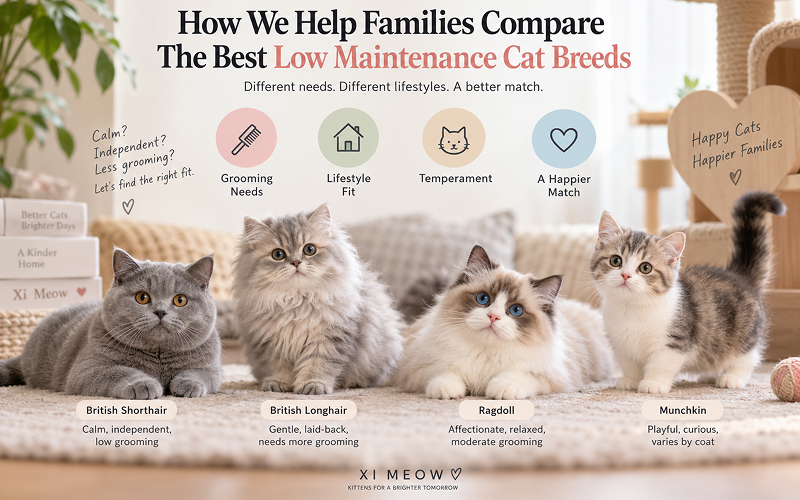
| Breed | Grooming | Typical Interaction Style | What to Consider |
|---|---|---|---|
| British Shorthair | Lower | Calm, relatively independent | Still needs play and activity |
| British Longhair | Higher | Calm, independent yet affectionate | Regular coat care |
| Ragdoll | Moderate | Affectionate, people-oriented | Regular brushing and companionship |
| Munchkin | Varies by coat | Playful, curious | Activity and accessible home setup |
These are breed tendencies rather than guarantees. Individual kittens can differ considerably in personality.
Should Maintenance Be the Deciding Factor?
We would not recommend choosing on maintenance alone.
Ask yourself what you can realistically maintain for the next decade or longer. How much brushing are you comfortable doing? Do you enjoy interactive play? Would you prefer a cat that regularly seeks your company, or one that is more comfortable doing its own thing?
Those answers tell us much more than simply searching for breeds of cats with lower maintenance needs.
How We Help Families Compare Breeds at Xi Meow
At Xi Meow, we work with British Shorthair, British Longhair, Ragdoll and Munchkin kittens. When families tell us they want cat breeds that are easy to manage, we first find out which part of cat ownership they are most concerned about.
We can then discuss typical breed characteristics alongside what we have observed about the individual kittens available.
The goal is not to find the cat that requires the least from you. It is to find one whose grooming, activity and companionship needs are a realistic match for the care you are happy to provide.
You can book a viewing to meet our kittens and talk to us about what everyday life with each breed may look like.
Frequently Asked Questions
What are the best low maintenance cat breeds for first-time owners?
British Shorthairs are often considered manageable because of their short coat and relatively calm temperament. However, the best fit still depends on your preferred level of grooming, activity and companionship.
Are British Shorthairs easy to care for?
British Shorthairs generally need less coat maintenance than long-haired breeds and can be relatively independent. They still require regular play, grooming, litter care, suitable nutrition and veterinary attention.
Are long-haired cats always high maintenance?
Not necessarily, but longer coats usually require more frequent brushing to prevent tangles and manage shedding. Owners considering British Longhairs or Ragdolls should be comfortable including regular grooming in their routine.
What cat breed is suitable for busy working adults?
Independent cat breeds such as the British Shorthair may suit some working adults, but no cat should be left without adequate interaction, enrichment and daily care for extended periods.
Should I choose a cat based on how low maintenance it is?
Maintenance is only one factor. Temperament, activity level, grooming needs and how much companionship you want should all be considered when deciding which breed fits your household.
