




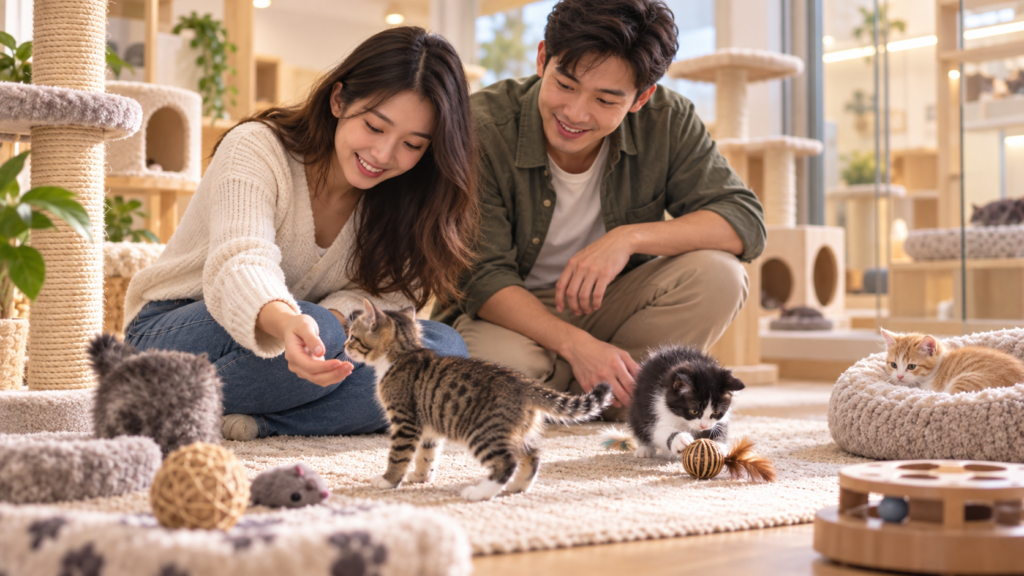
Choosing a cat for the first time is exciting, but we find that appearance often becomes the easiest part of the decision.
A family may arrive already drawn to a particular coat colour or breed, then realise during a kitten viewing that another kitten’s temperament feels much more compatible with the way they live. We often see this happen, which is why we encourage first-time owners to spend some time observing before deciding.
For us, choosing a cat means looking at three things together: the kitten in front of you, the environment it has been raised in, and the home you are offering it. Breed can give you some useful expectations, but individual kitten behaviour, socialisation and your own routine matter just as much.
Key Takeaways
- When choosing a cat, observe the kitten’s health, movement, behaviour and living environment rather than relying on photographs alone.
- A confident kitten is not automatically a better match. Watch how each kitten approaches, plays, responds to handling and settles afterwards.
- Cat breed characteristics can guide your decision, but individual temperament still varies within a breed.
- For example, families considering a purebred British Shorthair are often attracted to the breed’s comparatively calm, steady nature. However, one British Shorthair may be much more playful or people-focused than another.
- Ask about veterinary records, vaccinations, microchipping, pedigree information, health screening and the kitten’s everyday personality before reserving.
- Singapore cat owners should also consider licensing, housing limits and home safety before bringing another cat home.
What Should You Look for First When Viewing a Cat in Person?
Whenever someone visits us to choose a cat, we suggest spending the first few minutes simply watching.
You can learn quite a lot before you even pick a kitten up.
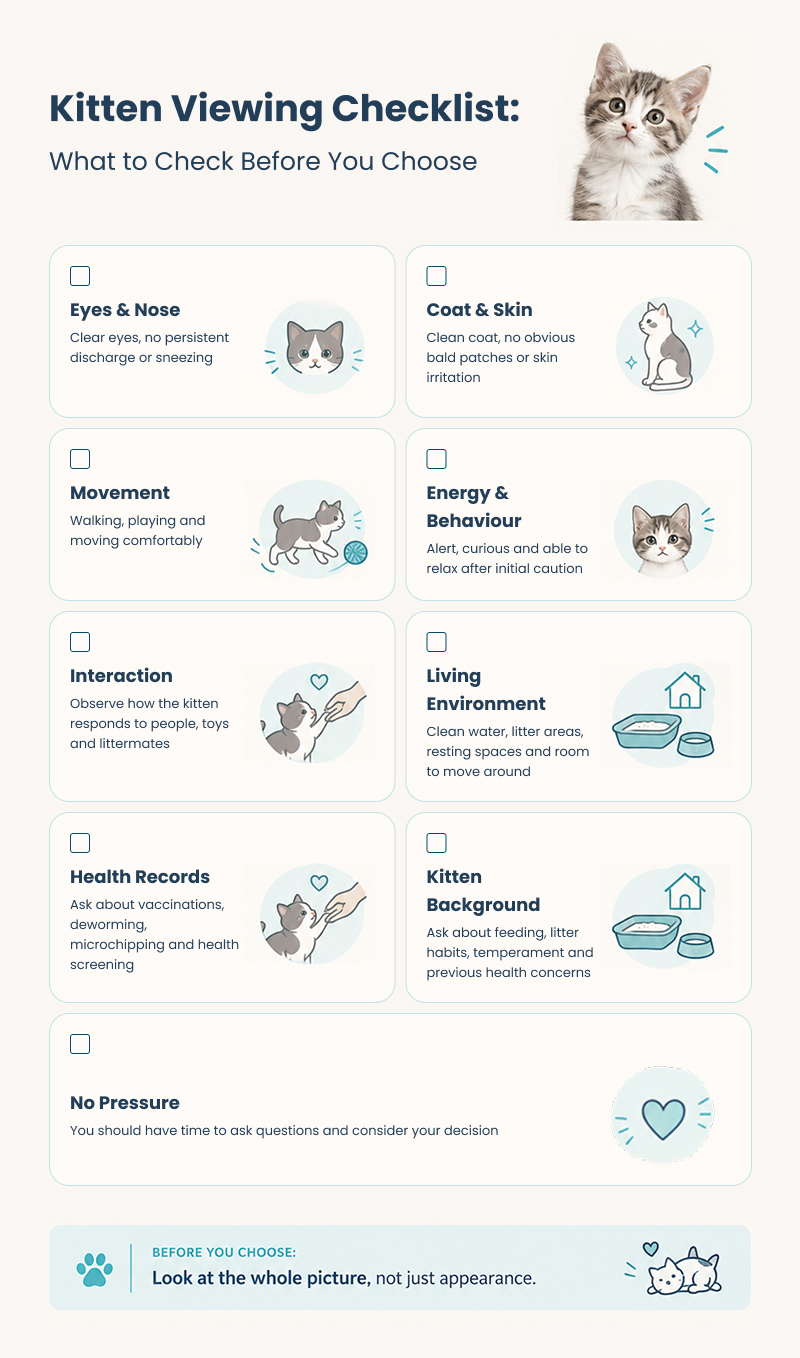
Look at the environment first. Cats naturally shed fur, scatter litter and make the occasional mess, so we would not expect a cattery to resemble a showroom. What matters more is whether the space is generally clean, well maintained and arranged around the cats’ needs.
There should be suitable litter areas, clean water, comfortable resting spaces and enough room for kittens to play, explore or retreat.
Then look at the kittens themselves.
Some basic signs of a healthy kitten include bright, clear eyes, a reasonably clean coat, comfortable movement and an alert response to the environment. A viewing cannot replace a veterinary examination, but it can tell you when you need to ask more questions.
We also recommend watching how the kittens behave with one another.
Are they playing and exploring? Can they disengage from play and settle? Does a kitten investigate something new after initially being startled?
Try not to judge one isolated moment too heavily. A kitten sleeping through part of your visit may simply have exhausted itself playing earlier. A cautious kitten may need longer to decide that you are safe.
This wider context is why we rarely recommend choosing purely from photographs when you buy a kitten in Singapore. The kitten you find visually appealing online may not necessarily be the one whose personality feels most natural when you meet.
How Can You Tell Whether a Cat’s Temperament Suits Your Home?
There is no short temperament test that can tell you exactly what a kitten will be like as an adult.
Instead, we look for patterns. What does the kitten do when someone unfamiliar enters? How does it play? How quickly does it recover after something surprises it? What has its regular caregiver observed when visitors are not around?
Research and veterinary guidance also support the importance of early positive experiences. We recommend gentle, gradual and positive exposure to people, handling, household sounds, transport and other experiences kittens are likely to encounter later in life.
That early socialisation can influence kitten behaviour, but personality still varies considerably between individuals.
What Does a Cat’s First Response to You Tell You?
How true is “the cat chooses you”?
One mistake we often see a first-time cat owner make is assuming that the kitten that approaches first must be the friendliest.
It may simply be the boldest.
One kitten might immediately climb onto your lap. Another may watch from a short distance, approach after several minutes and then remain quietly beside you. Both may grow into affectionate cats, but their preferred style of interaction could be very different.
Instead of asking, “Which kitten likes me most?”, we encourage families to ask, “Which type of interaction would I enjoy living with every day?”
If you prefer a calmer household, the kitten constantly climbing, chasing and demanding interaction may not automatically be your best match. Conversely, someone who enjoys frequent play and interaction may appreciate exactly that personality.
What Should You Look for When Playing With or Handling a Kitten?
During a kitten viewing, we prefer to let kittens approach and interact rather than immediately passing them from person to person.
Try introducing a toy. You may see one kitten chase instantly while another watches before joining. Some repeatedly return to play, while others lose interest quickly.
These small differences can help you understand their energy levels.
Handling also gives some information, provided it remains gentle. Not every affectionate cat enjoys being carried for long periods. We have seen cats that actively seek human company but would much rather sit beside someone than be held.
Pay attention to what happens after you put the kitten down. Does it remain tense and retreat, or does it quickly resume exploring and interacting?
For families with young children, we would discuss this particularly carefully. A kitten described as friendly should never be expected to tolerate rough handling. Children still need to learn how to recognise when a cat wants to move away.
Which Cat Breed Is Likely to Suit Your Household?
Breed is useful when choosing a cat, as long as you treat breed traits as tendencies rather than guarantees.
People looking at British Longhair kittens should also consider grooming. Their longer coat means brushing needs to become part of your routine rather than something you only do occasionally.
Your daily routine matters just as much as the breed name.
Are you away at work most weekdays? Do you have children or another pet? How much grooming are you prepared to do? Do you want frequent interaction, or would you prefer a cat that can entertain itself for parts of the day?
The more honestly you answer these questions, the easier choosing a cat becomes.
What Should You Ask Before Reserving a Cat?
A good viewing should also involve plenty of questions.
We would rather someone ask too many questions than reserve a kitten without understanding what they are committing to.
Which Health and Pedigree Records Should You Check?
Ask what veterinary care and health screening the kitten has received and what records will be provided when it leaves.
Depending on the kitten and breed, this may include vaccination and deworming records, microchip information, health screening results, pedigree documents and relevant information about the parents.
Do not hesitate to ask what a test actually checks for.
Health screening helps identify particular risks, but it cannot guarantee that a kitten will never become ill. What matters is that you understand what has been screened, what documentation supports it and what veterinary care the kitten has already received.
What Should You Ask About the Individual Kitten?
We think this is one of the most valuable parts of deciding on a cat.
We have met families interested in Munchkin cats because of their distinctive appearance. We encourage them to look beyond that first impression and consider the individual kitten’s playfulness, confidence and interaction style, while understanding any breed-specific care considerations.
Ask how the kitten behaves when visitors are not there. Is it usually adventurous or cautious? Does it seek people out? How does it interact with other kittens? Does it enjoy being held? What food and litter is it accustomed to? Has anything previously caused concern?
We also encourage people to ask a question that is often overlooked: “Is there anything about this kitten’s personality that you think may not suit my household?”
The answer can be more useful than hearing only positive traits.
What Should Singapore Owners Check at Home?
From 1 September 2026, all pet cats in Singapore must be licensed. First-time applicants must complete the Pet Ownership Course, and cats must be microchipped before a licence application.
Housing limits matter too. HDB households may generally keep up to two cats, while private premises have a maximum of three cats and/or dogs, subject to the applicable rules.
We therefore encourage families to check these practical matters before reserving another kitten.
Home safety matters as well. Windows and balconies may need suitable barriers or meshing, while doors should be managed carefully to prevent roaming. Think about where litter trays, food, scratching areas and resting places will go before the kitten arrives.
Before choosing your first cat, these preparations are every bit as important as selecting a breed.
What Red Flags Should You Watch for During a Kitten Viewing?
A kitten viewing should help you feel more informed, not more pressured.
We always tell first-time owners to look at the overall picture rather than treating one small detail as proof that something is wrong. A kitten may hide because it is tired or seem less playful simply because it has just woken up. What concerns us more is when several warning signs appear together or when owners consistently avoid reasonable questions.
Some red flags worth paying attention to include:
- Multiple kittens appearing lethargic or unwell.
- Kittens that seem consistently fearful or distressed. Some caution around strangers is normal, but kittens that remain extremely withdrawn, panic when approached or appear uncomfortable with ordinary human contact may need more context around their socialisation.
- Poor hygiene throughout the viewing area. One recently used litter tray is very different from consistently dirty bedding, heavily soiled areas, stale water or strong odours throughout the space.
- Reluctance to discuss health records. You should be able to ask about vaccinations, deworming, microchipping, health screening and previous veterinary concerns without feeling that the questions are unwelcome.
- Very little information about the individual kitten. We would expect someone caring for a kitten regularly to know something about its temperament, feeding routine, litter habits and interaction style.
- Pressure to reserve immediately. Limited availability may be genuine, but choosing a cat is a long-term decision. You should still have enough opportunity to ask questions and consider whether the kitten is right for your household.
- Claims that sound absolute. Be cautious of guarantees that a kitten will never develop a health problem, will definitely have a particular adult personality or will automatically get along with every child or pet.
We also pay attention to how they answer questions.
A responsible conversation should include both strengths and practical considerations. If a kitten is especially energetic, needs more grooming or tends to take longer to warm up to new people, we think families should know that before deciding.
For us, transparency matters more than presenting every kitten as perfect.
A good kitten viewing should leave you with a clearer understanding of the kitten’s health, personality and care needs. If you leave with more unanswered questions than when you arrived, it is reasonable to take more time before making a commitment.
Choosing a Cat With Xi Meow
At Xi Meow, we do not see choosing a cat as simply selecting a breed, colour or kitten from a photograph.
During a viewing, we want to understand what you are actually looking for. We often ask about your working hours, previous experience with cats, household members, other pets and the type of interaction you hope to have with your cat.
That context helps us explain what we have observed about individual kittens rather than relying entirely on general breed descriptions.
For us, a good match is one where you leave understanding not only why you like a kitten, but what living with that kitten is likely to ask of you.
If you are ready to start choosing a cat, you can book a viewing with Xi Meow, meet our kittens in person and speak with us about which personality and breed may fit naturally into your home.
Frequently Asked Questions About Choosing a Cat
Should I choose the kitten that approaches me first?
Not necessarily. It may simply be more confident with strangers. Give quieter kittens time to approach as well and compare their interaction styles rather than treating the first approach as a test.
Is a shy kitten unsuitable for a first-time owner?
Not automatically. We often see kittens that take longer to observe unfamiliar people before approaching. Ask how the kitten behaves with familiar caregivers and whether it becomes more relaxed once comfortable.
Should I choose a male or female cat based on personality?
We would not use gender alone to predict temperament. Genetics, early experiences, socialisation and individual personality can all influence how a cat behaves.
Is choosing an adult cat easier than a kitten for a first-time owner?
Sometimes. An adult cat usually has a more established personality, while a kitten requires more guidance as habits and confidence develop. Which is easier depends on what you want and how much time you can commit.
How long should a kitten viewing take?
There is no ideal number of minutes. We recommend staying long enough for the initial excitement or caution to settle so you can observe play, movement, interaction and recovery.
What are the biggest red flags during a cat viewing?
We would pay attention to consistently poor hygiene, unexplained health concerns, unwillingness to discuss medical records, pressure to reserve a cat immediately or an inability to tell you anything meaningful about the individual kitten.
