




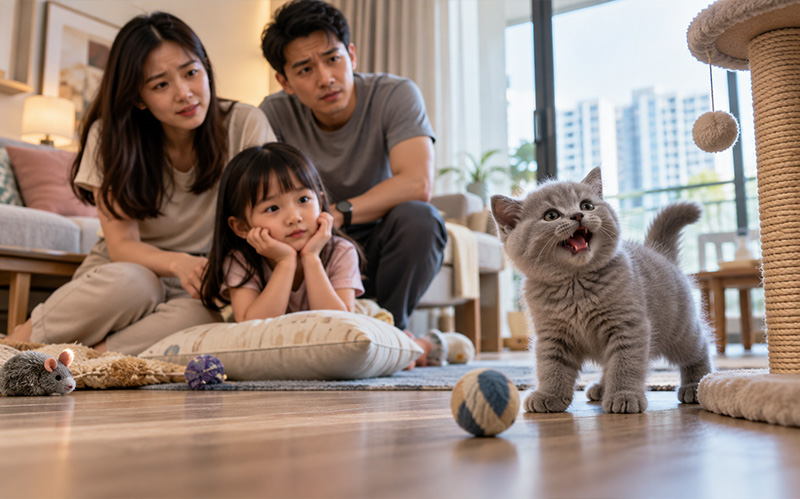
One practical question families sometimes ask us before choosing a kitten is: are cats loud?
For most households, cats are relatively quiet pets. However, quiet does not mean silent. A cat may meow for food, trill when greeting you, race across the floor during a burst of energy, scratch a post, or decide that midnight is the right time to chase a toy.
At Xi Meow, we work with British Shorthair, British Longhair, Ragdoll and Munchkin kittens. What we often see is that noise depends on the individual kitten, its routine and its environment, not only its breed.
Key Takeaways
- Cats are generally quiet household pets, but cat vocalisation varies between individuals.
- Kitten play, running and jumping can sometimes be more noticeable than meowing.
- Breed tendencies can offer clues, but they cannot guarantee how vocal a kitten will be.
- Repeated meowing usually has a reason, so look for patterns rather than simply labelling a cat noisy.
- A sudden change in vocalisation, especially alongside other behavioural changes, deserves veterinary attention.
Are Cats Loud Compared With Other Household Pets?
Generally, no. Cats spend much of the day resting, grooming and observing their surroundings quietly.
What families sometimes underestimate is activity noise. A kitten may barely meow yet make itself heard while sprinting over hard flooring, jumping from furniture or batting toys around.
So when families ask us, “Are cats loud?”, we separate vocal noise from activity noise. This gives a more realistic idea of what living with a kitten sounds like.
Which Cats Tend to Be Quieter at Home?
Breed can be a useful starting point, but we can’t promise a kitten will always be quiet.
Among the breeds we work with, British Shorthairs are generally known for a calmer, less demanding manner. Families considering a purebred British Shorthair may appreciate this, although individual personality still matters.
British Longhairs can show similar settled qualities. Ragdolls may be more communicative, but we often hear softer meows, chirps or trills rather than constant calling.
Munchkins may create more noise through activity. They are playful and curious, so families planning to buy a Munchkin cat should consider running, jumping, and play as well as vocalisation.
Rather than relying on lists of supposedly noisy cat breeds, we prefer to observe the kitten in front of us.
Why Do Cats Meow?
When owners ask us why cats meow, our first answer is communication.
A cat may vocalise because it wants food, attention, play or access to another room. It may also become more vocal when bored, unsettled or uncomfortable.
Research into domestic cat vocalisations supports the role of meowing in cat-human communication. A 2020 study on domestic cat vocalisations found that meows are commonly directed towards humans and can occur in different everyday contexts, including waiting for food and isolation.
This is why we tell owners to look for patterns. If a kitten meows at the same time every morning, it may associate that time with breakfast. If it calls when you leave, it may be seeking company.
A sudden increase in vocalisation is different. If it appears alongside changes in appetite, toileting, movement or behaviour, speak with a veterinarian.
Are Kittens Noisier at Night?
Sometimes, although usually because they are active rather than especially vocal.
Kittens can chase toys, jump, climb and suddenly race across the home. Even a kitten from a calm breed will still have energetic periods.
This is worth considering when buying a cat in Singapore, particularly if you live in an apartment or have family members who sleep early.
We often suggest active play before the evening meal, followed by a quieter wind-down period. Avoid accidentally teaching your kitten that persistent night-time meowing always earns food or attention.
Your setup can help too. Rugs soften footsteps on hard flooring, sturdy cat furniture reduces rattling, and quieter toys are better left out overnight than anything with bells.
Can You Encourage Quieter Habits?
You can influence routines, but you shouldn’t try to stop a cat from communicating.
Instead, work out what prompts the noise. Boredom may call for more enrichment. Food-related meowing may improve with a consistent feeding routine. Scratching can often be redirected towards a well-positioned scratching post.
Punishing a cat for meowing does not address the reason behind it and may make the interaction more stressful.
How We Help Families Choose With Noise in Mind
At Xi Meow, we know noise can matter when you live in an apartment, work from home, have young children or simply prefer a calmer environment.
During a viewing, we can discuss typical breed characteristics alongside what we have observed about the individual kittens available. We would rather help you understand a kitten’s temperament and activity level than simply label it as “quiet”.
If noise is a concern, book a viewing and tell us about your household routine. We can help you consider how a kitten may fit into everyday life.
Frequently Asked Questions
Are cats loud enough to disturb neighbours?
Usually not. Normal meowing and play are moderate, although running, jumping or persistent night-time vocalisation may be more noticeable in apartments with hard flooring.
Do kittens meow more than adult cats?
Some do, especially while adjusting or seeking food and attention. Others are naturally quiet. Individual temperament and learned routines matter greatly.
Which cat breed is the quietest?
There is no guaranteed quietest breed. British Shorthairs are commonly associated with quieter behaviour, but every cat has its own temperament and communication style.
Should I worry if my cat suddenly becomes noisy?
A sudden increase in vocalisation can signal stress, discomfort or illness. If it persists or appears with other changes, arrange a veterinary assessment.
